
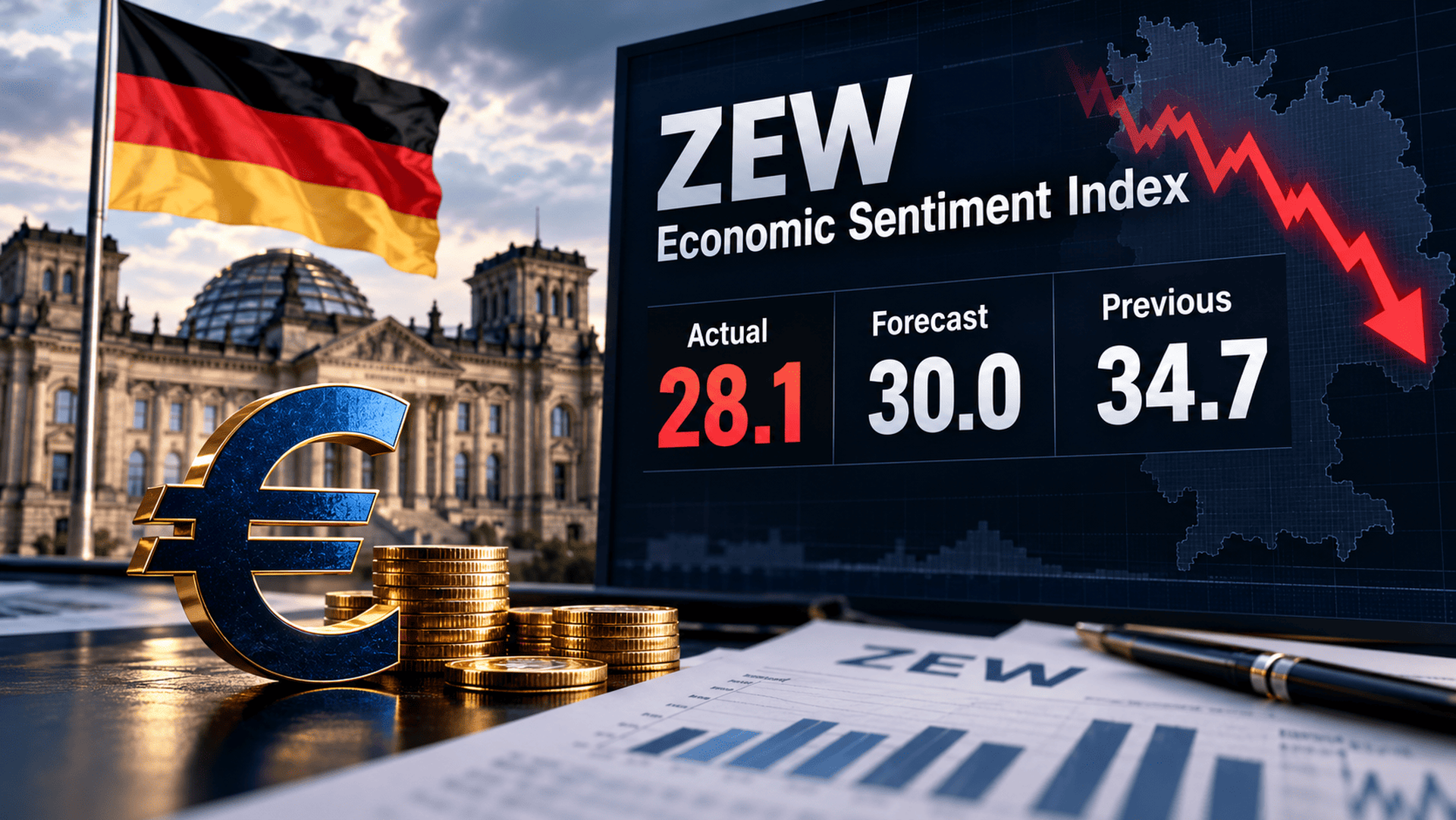
Germany's economic outlook weakened in October as the ZEW Economic Sentiment Index fell to 28.1, below the market consensus of 30.0 and September's 34.7. The decline highlights a loss of confidence among financial-market experts, raising questions about the durability of Germany's economic recovery and the implications for the euro.
The Real Market Surprise
The index missed expectations by 1.9 points and declined 6.6 points from the previous month. Although both figures are negative, their implications differ.
Markets had already anticipated weaker sentiment, making the relatively modest forecast miss more relevant to the immediate reaction than the full monthly decline. Furthermore, the index remains positive, indicating that expectations have deteriorated without turning broadly pessimistic.
The release therefore signals softer confidence rather than definitive evidence of an economic contraction.
Why EURUSD and European Markets Matter
For EURUSD, weaker German expectations could become a bearish influence if investors increasingly anticipate slower Eurozone growth or a more accommodative European Central Bank.
However, the currency's response also depends on US economic data, Federal Reserve expectations and the direction of interest-rate differentials.
German equities face a more complicated transmission mechanism. Weaker domestic growth expectations may weigh on economically sensitive companies, while lower bond yields or a softer euro could provide selective support.
The DAX therefore need not move in the same direction as EURUSD.
Bullish and Bearish Scenarios
Bearish EURUSD scenario: Continued deterioration in German economic indicators, accompanied by falling German yields relative to US yields, would strengthen the case for euro weakness.
Bullish EURUSD scenario: Stabilizing economic indicators, resilient Eurozone activity or a weakening US dollar could offset the disappointing ZEW reading and support a recovery.
Neutral scenario: If investors treat the release as a limited confidence setback, EURUSD could remain driven primarily by US data and broader monetary-policy expectations.
What Matters Next
Investors should assess the ZEW current-conditions component, upcoming German and Eurozone business surveys, and changes in ECB rate expectations. EURUSD's reaction alongside German-US yield spreads will help determine whether the report has lasting market significance.
EWM Trader Takeaway
The October ZEW release is a negative growth-confidence signal, but not automatically a major bearish catalyst for the euro. Traders should distinguish between disappointing economic expectations and confirmed changes in monetary-policy pricing before interpreting the release as a directional market signal.