
Price rises, then pulls back. You interpret the decline as a correction before another advance—but it keeps falling. Was your retracement estimate too shallow, or has the wave count itself become invalid?
Those are different problems. Missing an expected target is not the same as breaking a structural rule. Invalidation gives an interpretation a clear boundary: a condition that requires you to stop relying on it.
Start with the pattern you are testing
This article examines the standard impulse, a five-wave structure. Waves 1, 3 and 5 move in its direction, while waves 2 and 4 retrace part of the preceding movement.
The waves being compared must belong to the same wave degree: the same level within the larger structure. Five visible swings are not sufficient to establish an impulse. Its internal subdivisions must also fit, including the requirement that wave 3 itself be an impulse.
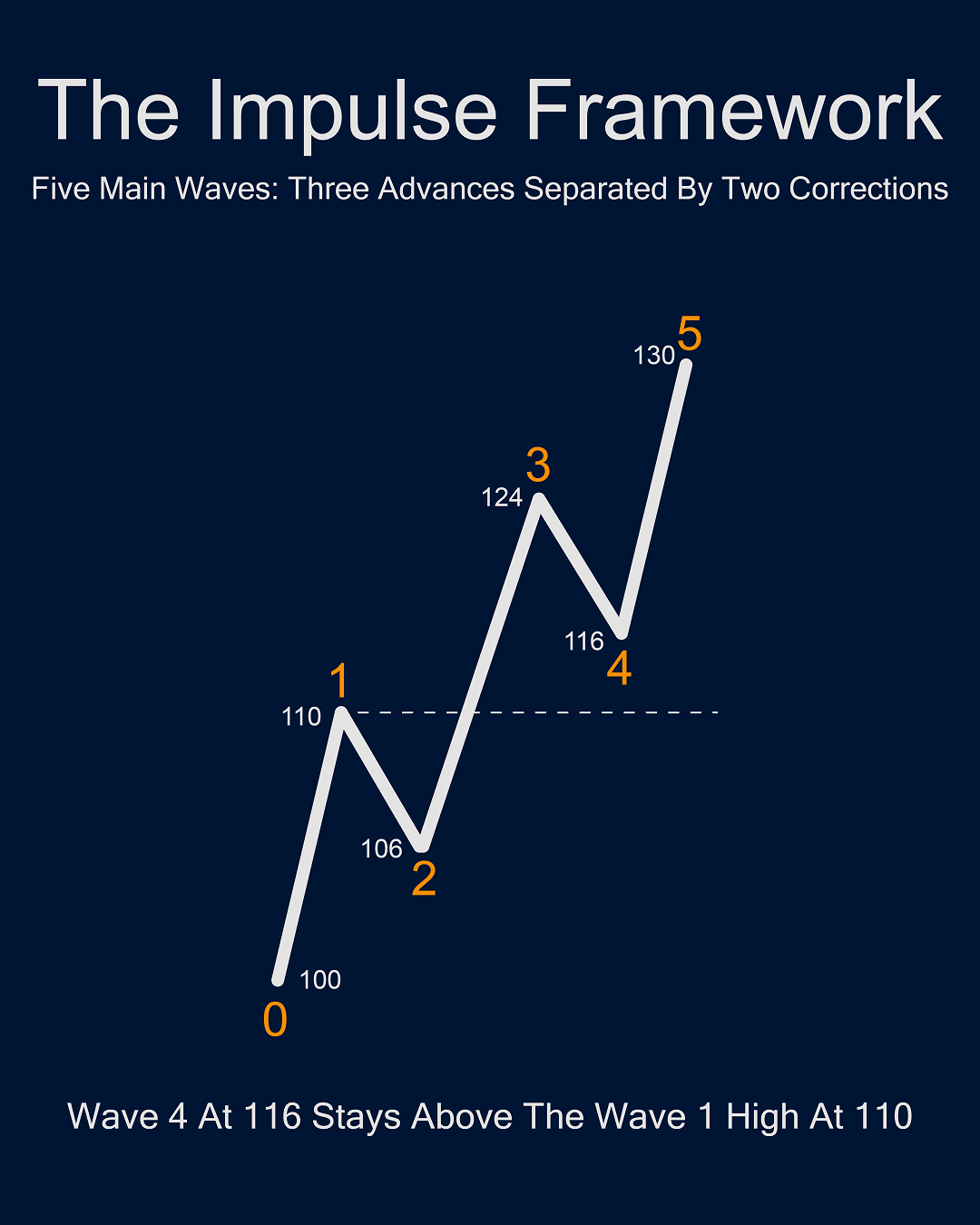
Here, wave 1 rises from 100 to 110, followed by wave 2 at 106. Wave 3 reaches 124, wave 4 retreats to 116, and wave 5 advances to 130. Changing selected turning points lets us test when this interpretation stops satisfying its rules.
Wave 2: a full retracement invalidates the count
Wave 2 cannot fully retrace wave 1. If an upward first wave begins at 100, a second wave returning to 100 invalidates that count, as does a move below it. Reverse the price directions when applying the rule to a downward impulse.
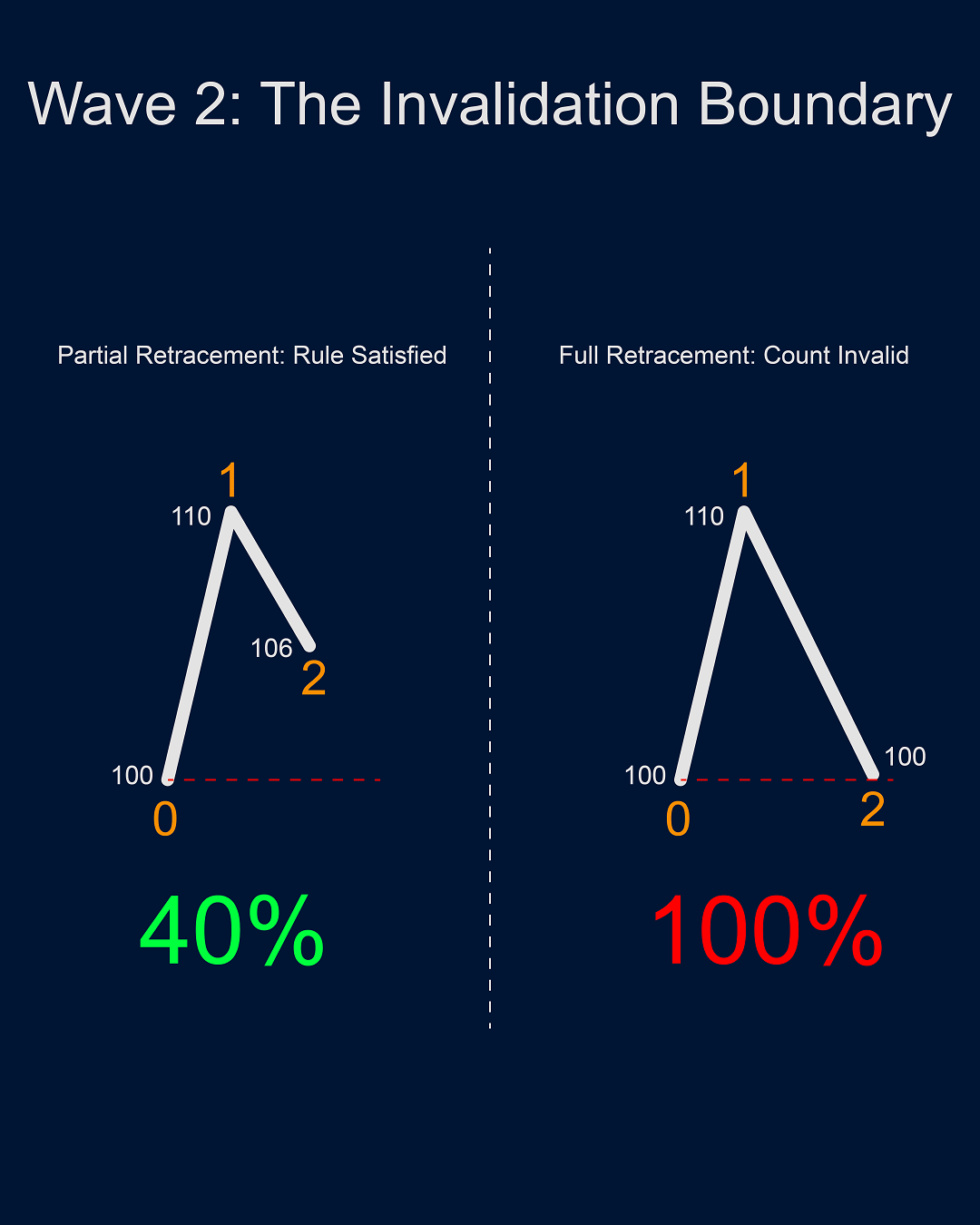
In the first case, the correction gives back 4 units of a 10-unit advance: 40%. Calling a correction “deep” is therefore insufficient to invalidate it. The relevant test is its relationship to the start of wave 1.
If invalidation occurs, the decline can no longer be treated as wave 2 of that specific count. This alone does not determine where price moves next.
Wave 4: missing a Fibonacci level is different from overlap
In a standard impulse, wave 4 cannot enter wave 1’s price territory. We apply that rule strictly to a hypothetical cash-market example. Specialist references discuss rare futures-market exceptions, but these should not become a routine justification for accepting overlap.
In our original sequence, wave 3 advances from 106 to 124, a distance of 18 units. A decline to 116 retraces 8 units:
Retracement = 8 ÷ 18 × 100 ≈ 44.4%
That exceeds an anticipated 38.2% retracement, yet it does not violate the overlap rule. The proposed fourth wave remains above wave 1’s high at 110.
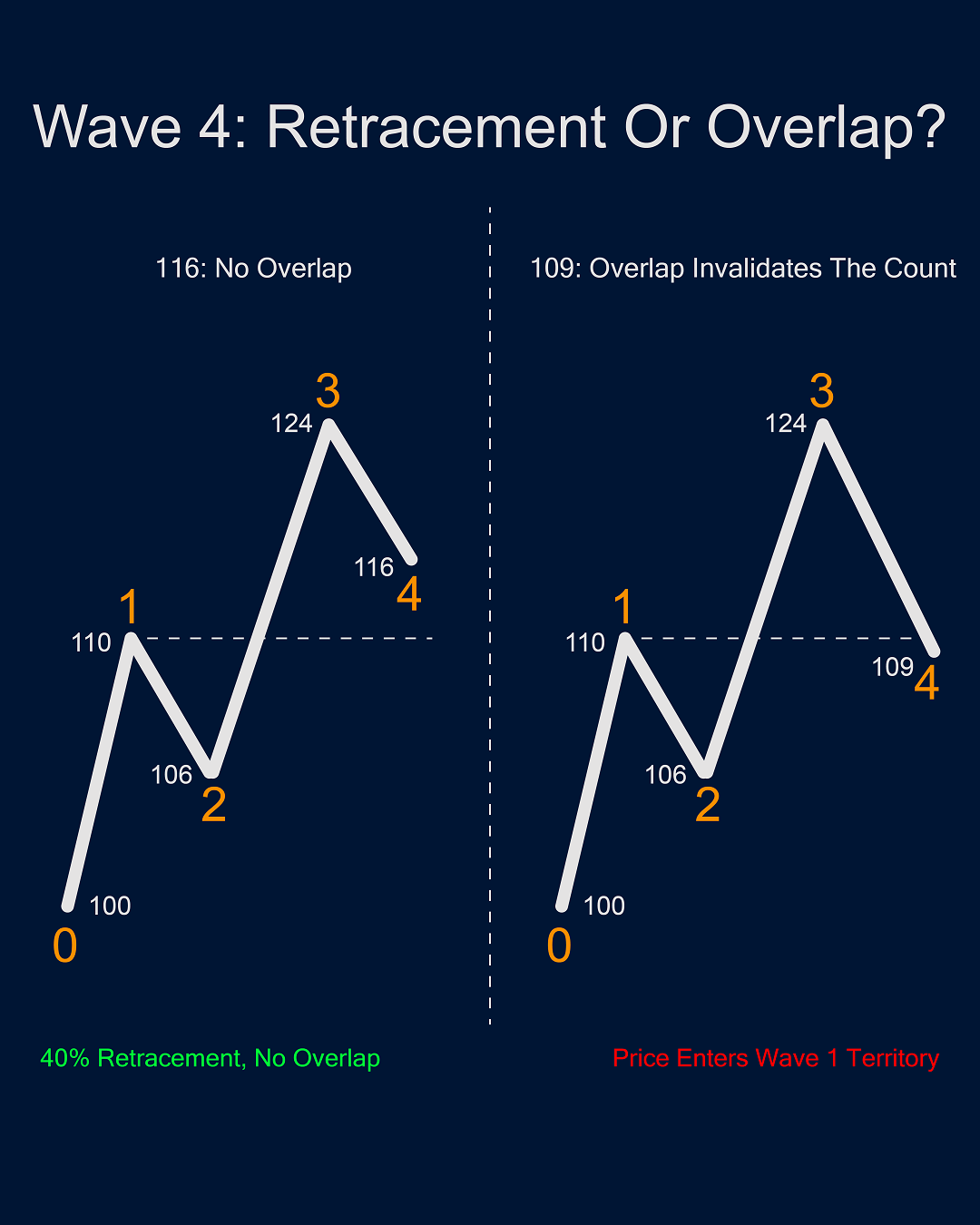
Fibonacci ratios help estimate possible turning areas; they do not override structural requirements. Losing a Fibonacci level should therefore not be treated as equivalent to wave-count invalidation.
Wave 3: it does not have to be the longest
Wave 3 cannot be the shortest of waves 1, 3 and 5. It may be shorter than wave 1 if wave 5 is shorter still. The comparison concerns price movement, not the time each wave takes.
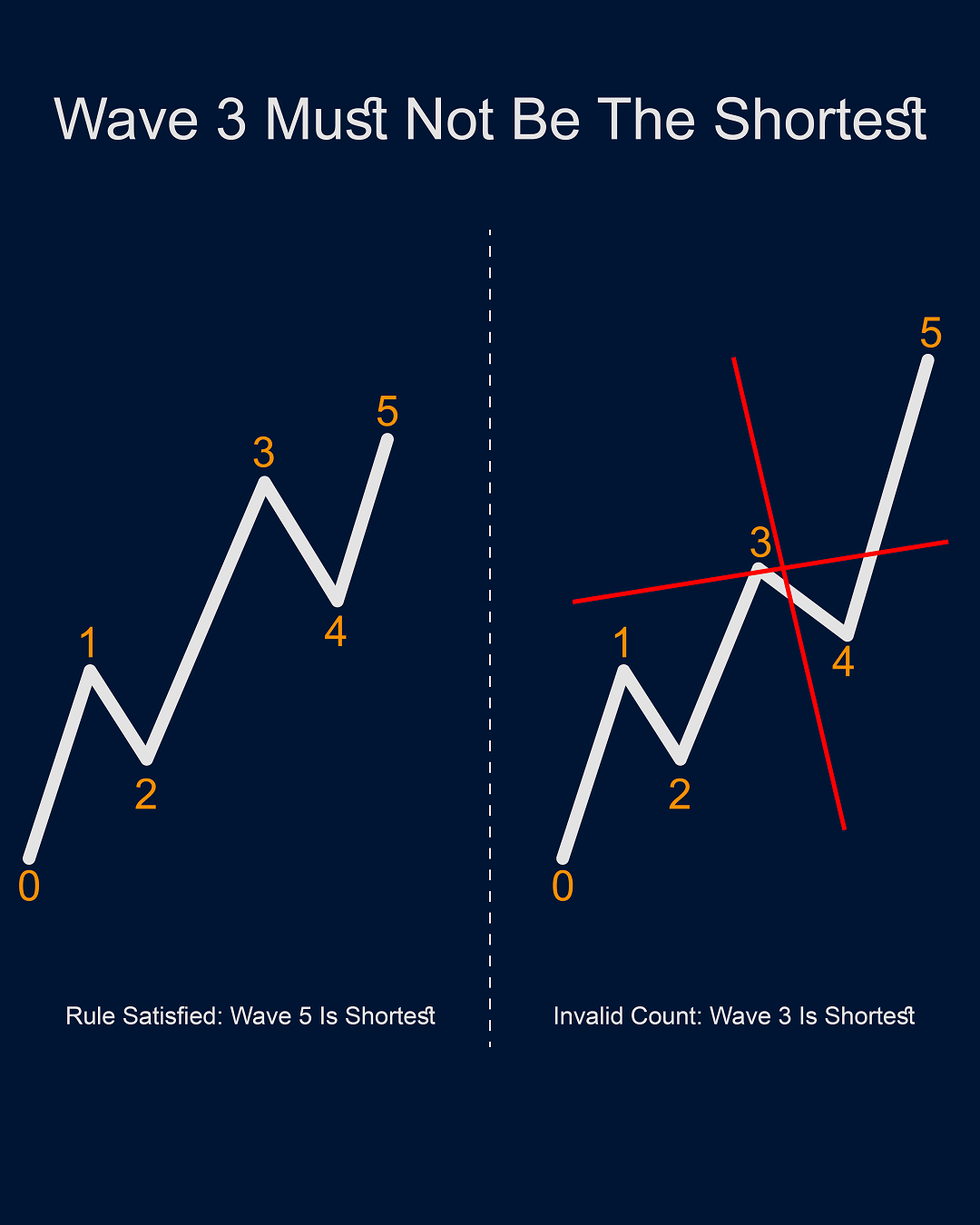
On the left, wave 1 rises from 100 to 112, wave 3 from 106 to 115, and wave 5 from 113 to 120. Their lengths are 12, 9 and 7 units. Wave 5 is shortest, so this comparison satisfies the rule.
On the right, wave 5 extends from 113 to 123, increasing its length to 10 units. The 9-unit third wave is now shorter than both waves 1 and 5, invalidating the count.
This is a length test only. Passing it does not establish that a sequence meets every requirement of a completed impulse.
Can you rescue the count by calling it a diagonal?
Diagonals permit overlap, but they are separate patterns with their own structural requirements and permitted positions. An impulse does not automatically become a diagonal when overlap appears. Its subdivisions, shape and location must support that interpretation.
Other explanations may include an unfinished correction or a different endpoint for an earlier wave. Each alternative needs evidence of its own. Failure of the primary count does not prove the alternative.
Make invalidation useful
Before adopting a count, record its proposed pattern, wave degree and invalidation condition. When price contradicts your expectations, identify what failed: a target estimate, an assumption that a wave had finished, or a structural rule.
Also distinguish analytical invalidation from a stop-loss order. One tests an interpretation; the other manages a trade’s risk. Risk limits may require an exit before the count becomes invalid, and a stop order does not guarantee execution at its specified price.
The boundary tests the interpretation; it does not predict the next move. Its value lies in making your analysis reviewable and defining when to stop relying on it.